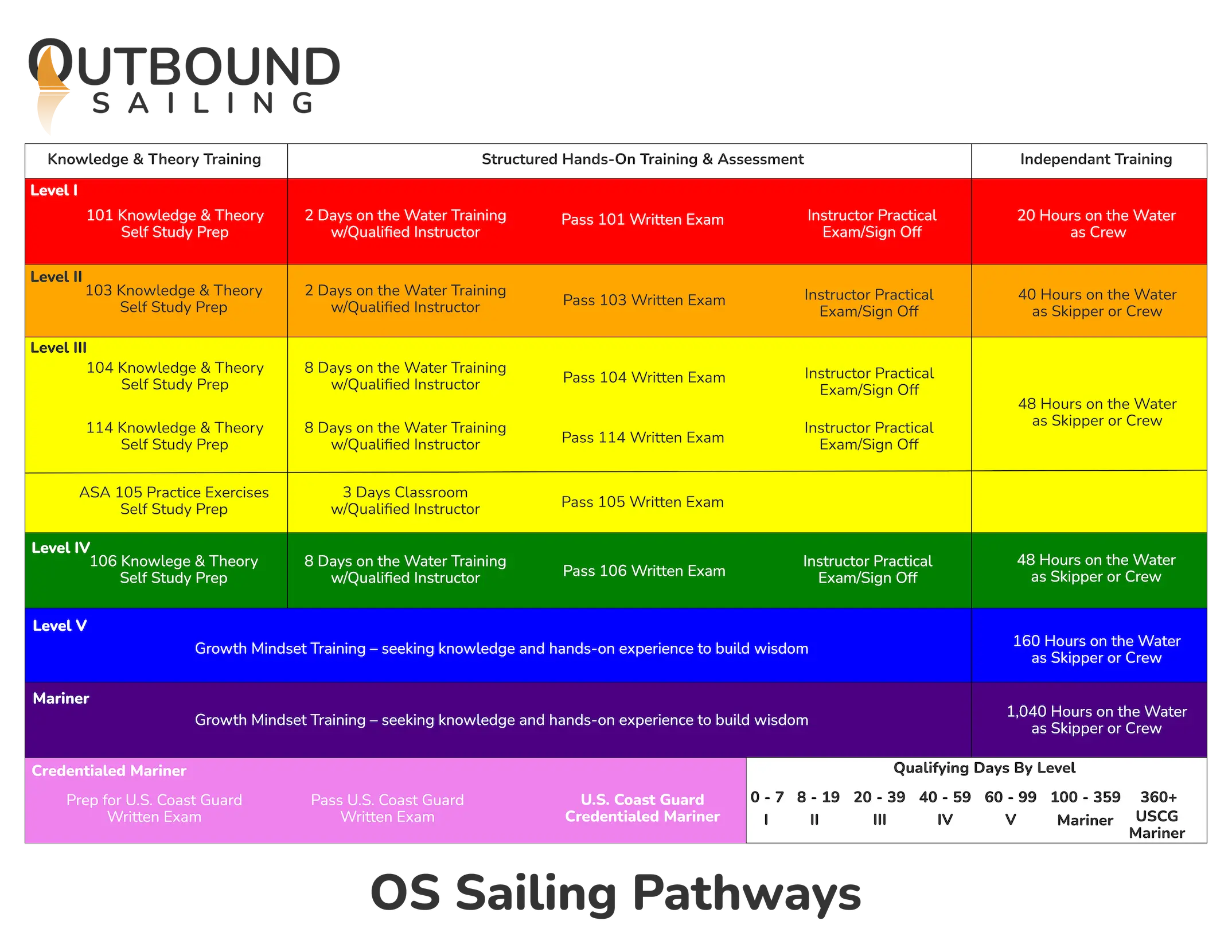
The Inland / Lakes Skipper pathway is designed for sailors who want to confidently skipper sailboats on lakes and protected inland waters.
Students begin by learning the fundamentals of sailing — how a sailboat works, basic sail trim, rules of the road, docking, anchoring, and core seamanship skills — while building real experience as crew. From there, students transition into skippering sailboats independently on inland waterways.
This pathway emphasizes hands-on experience, repetition, and confidence-building rather than rushing toward certification milestones. By the end of this pathway, sailors are capable of safely skippering monohull sailboats up to approximately 40 feet on lakes and inland waters in typical daytime conditions.
Most students complete this pathway through a combination of:
- ASA 101 and ASA 103 instruction
- Community sailing events as crew
- Independent inland sailing time as skipper
Outcome:
Confident inland skipper with a solid foundation in seamanship and real on-the-water experience.
This pathway stands on its own. Many sailors choose to remain Inland / Lakes Skippers and continue sailing independently for years without progressing further.
The Bareboat Coastal Skipper pathway is for sailors who want to bareboat charter monohulls and catamarans on coastal waters and island destinations.
Building on Inland / Lakes Skipper experience, students develop the skills required for coastal navigation, liveaboard sailing, crew management, and multi-day chartering. Training focuses on real-world coastal sailing scenarios — anchoring, mooring, passage planning between islands, weather awareness, and operating larger cruising sailboats.
Instruction takes place aboard full-sized cruising yachts in the Virgin Islands, allowing students to train on the same boats they’ll later charter independently as alumni.
Following instruction, sailors build confidence through independent skippering experience that reinforces real-world decision-making and command skills.
This pathway is ideal for sailors planning vacations with friends or family in popular charter regions such as the Caribbean, Bahamas, and similar coastal cruising grounds.
Outcome:
Bareboat-ready coastal skipper qualified for most charter companies worldwide, with the judgment and experience to sail independently in coastal environments.
Some sailors choose to stop here and enjoy a lifetime of coastal cruising without moving on to offshore passagemaking.
The Offshore Skipper pathway is intended for sailors who want to plan and skipper offshore passages involving continuous multi-day sailing beyond protected coastal waters.
This pathway builds upon Bareboat Coastal Skipper experience and includes additional training focused on offshore navigation, managing multi-day watches and crew fatigue, offshore weather systems, and command-level decision-making. Sailors learn to manage vessels and crews during extended passages where conditions, sleep cycles, and risk management differ significantly from coastal sailing.
As part of this pathway, sailors complete advanced coastal cruising training (
ASA 106), which prepares them for overnight sailing and longer island hops, before progressing into true offshore passage training and skippering under ASA 108 requirements.
Offshore Skipper training is experience-intensive by design. Offshore competence is built over time through accumulated miles, days at sea, and progressively increasing responsibility — not a single course.
Outcome:
By the end of this pathway, sailors are prepared to plan and execute multi-day offshore passages with confidence, judgment, and sound seamanship.
This pathway is optional and not necessary for most sailors. It is best suited for those with specific offshore cruising or passagemaking goals.